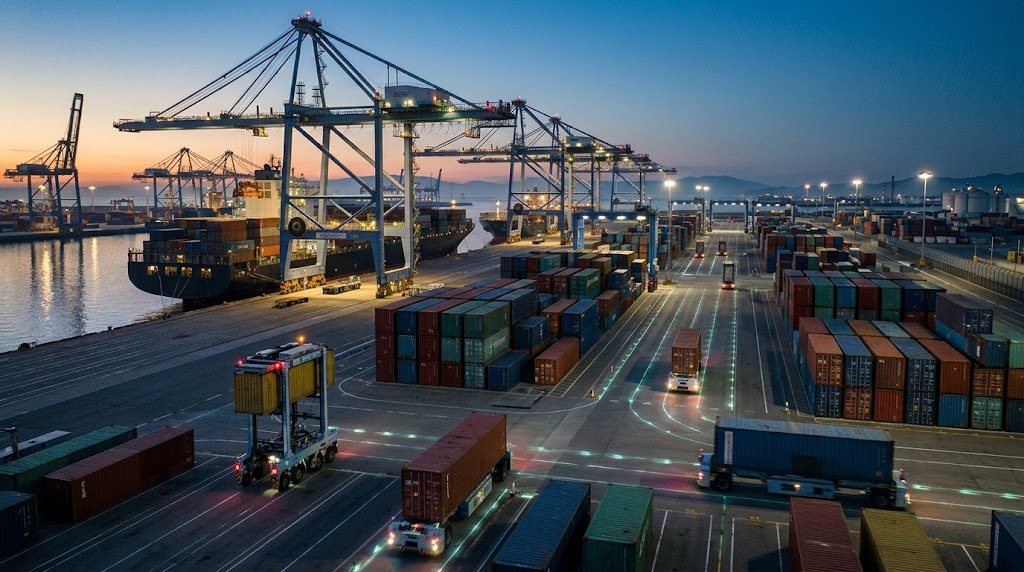
Automated terminals, digital twins and cargo forecasting platforms are turning the world's great ports into technology hubs. Here is what Singapore, Rotterdam and Los Angeles are building.
The world's busiest ports are becoming some of its most advanced technology sites. Electric cranes move containers under remote control, driverless vehicles shuttle boxes across terminals and digital platforms forecast cargo flows weeks in advance.
For anyone who moves goods internationally, these investments matter. Smarter ports mean more predictable schedules, faster turnaround for ships and cleaner operations. Three ports on three continents show how far the shift has already come.
Singapore's Tuas Port: automation at a new scale
Singapore is building what the Maritime and Port Authority of Singapore (MPA) describes as a new chapter for its port. When complete in the 2040s, Tuas Port will handle 65 million twenty-foot equivalent units (TEUs) a year, nearly double the 37.5 million TEUs Singapore handled in 2021.
The physical scale is remarkable. At completion, Tuas will cover about 1,337 hectares and offer 66 berths along 26 kilometers of waterfront, able to serve the largest container ships afloat. Phase 1 alone used 221 concrete caissons, each weighing 15,000 tons, to form 8.6 kilometers of seawall.
The technology is just as ambitious. According to the MPA, Tuas operations combine:
- Electrified automated yard cranes that stack and retrieve containers without operators in the cab.
- Automated guided vehicles (AGVs) that carry containers between the yard and the wharf.
- A central control center from which operations are managed remotely.
- A private 5G network deployed by port operator PSA to connect AGVs and automated cranes.
The first two berths began operating in December 2021, and Tuas Port officially opened in September 2022. Phase 1 is designed for 21 berths and 20 million TEUs a year once fully operational in 2027.
Building it has been a collaborative effort on a national scale. Phase 1 reclamation took 34 million labor hours and involved more than 450 companies. Phase 2 is using a further 227 caissons to form 9.1 kilometers of seawall, with all caisson fabrication completed in April 2022.
Tuas is also designed as the anchor of a wider economic zone. The MPA plans for the port to connect with the nearby Jurong Lake District, Jurong Innovation District and Tuas Industrial District, linking shipping directly with research, advanced manufacturing and commercial activity.
Cleaner operations built into the design
Automation and sustainability go hand in hand at Tuas. PSA expects its electrified AGVs to cut carbon emissions by about 50% compared with the diesel prime movers they replace, and it aims for Tuas Port to reach net-zero emissions by 2050.
The buildings follow the same approach. The Tuas Maintenance Base administrative building uses 58% less energy than similar buildings and generates enough solar power to offset its electricity use. The MPA is also developing a next-generation vessel traffic management system and its digitalPORT@SG platform to help ships turn around faster.
Rotterdam: a port that runs on data
The Port of Rotterdam has set a clear long-term goal: to build a "digital twin" of the port in four dimensions. A digital twin is a live digital model of the physical port, continuously updated by sensors, that lets planners see conditions in real time and test decisions before acting on them.
The foundation is already in place. The Port Authority runs a cloud Internet of Things platform, built with IBM, Cisco, Esri and Axians, that gathers sensor data on infrastructure, water and air quality across the port in real time. Its Harbour Master Management Information System plans, monitors and administers all shipping traffic in one digital environment.
Rotterdam's partners add further layers. The Portbase port community system digitizes the documents and administrative flows that accompany freight. An operational flow model forecasts water levels and current speeds, helping vessels plan safe and efficient passage.
Maasvlakte II: the remote-controlled terminal
Rotterdam is also home to one of the early showcases of terminal automation. APM Terminals Maasvlakte II, dedicated in April 2015, was designed from the start around electric, automated equipment powered by wind-generated electricity.
At launch the terminal featured eight remotely controlled electric ship-to-shore cranes, 54 automated rail-mounted gantry cranes and 62 battery-powered lift AGVs, with robotic stations that swap their battery packs automatically. Today APM Terminals reports a fleet of 73 lift AGVs, with about 80% of crane movements fully automated and the remainder handled remotely.
The terminal keeps improving. Two Super Quay Cranes, added in 2019, along with ongoing efficiency gains, were expected to raise its volume capacity by more than 20%.
Los Angeles: forecasting cargo before it arrives
Smart ports are not only about cranes and vehicles. Some of the most valuable innovation is in shared data. The Port of Los Angeles introduced its Port Optimizer platform, developed with Wabtec, in 2017 and has expanded it steadily since.
The platform gives cargo owners, terminal operators and truckers a common view of what is coming. Its tools include:
- Signal, a daily view of incoming cargo with projected volumes up to three weeks out.
- Horizon, which forecasts container movements up to six months ahead.
- Turn Times, real-time truck turn times covering all 12 container terminals in the San Pedro Bay complex.
- Return Signal, which tells truckers when and where to return empty containers.
By early 2022 the platform covered about 70% of the import data for the San Pedro Bay port complex. That kind of visibility helps an ecosystem that the port says supports one in nine jobs across five Southern California counties.
The common thread: shared visibility
Singapore, Rotterdam and Los Angeles have taken different routes, but their strategies share a clear logic. Each port is turning physical activity into data and then sharing that data with the companies that depend on it.
The payoff comes from coordination. When a terminal knows exactly when a ship will arrive, it can plan cranes and berths in advance. When truckers know turn times before they leave the depot, they can schedule pickups with confidence. When a port can model water levels, traffic and equipment in one digital environment, it can test improvements before making them.
Automation and shared data also reinforce each other. Remote-controlled cranes and driverless vehicles generate a constant stream of precise operating information, which feeds planning systems that make the next move faster. The result is a port that learns and improves continuously.
Putting port intelligence to work
Smart ports turn the waterfront into a source of reliable information as well as capacity. Exporters, importers and logistics teams can benefit directly:
- Plan with port data. Many ports now publish forecasts, vessel schedules and turn times. Build them into your shipping and inventory plans.
- Choose partners who connect. Forwarders and carriers that plug into port community systems can give you earlier and more accurate updates.
- Use sustainability as a selling point. Electrified terminals help shippers report cleaner supply chains to their own customers.
- Stay curious. Trade events and peer networks are an excellent place to compare notes on which digital tools deliver the most value.
Ports have always been the meeting points of global trade. With automation, digital twins and shared data platforms, they are becoming its intelligence hubs as well.
Sources
- Maritime and Port Authority of Singapore, Port of the Future: A New Chapter (Tuas Port overview)
- Port of Rotterdam, Digitisation: Control and Management, May 11, 2021
- APM Terminals, Maasvlakte II: Our Terminal
- The Maritime Executive, APM Opens Most Advanced Container Terminal, April 28, 2015
- Port of Los Angeles, Port of Los Angeles Rolls Out New Components to Port Optimizer Digital Platform, February 28, 2022