Electric vehicles went from 4% of new car sales to one in four in five years. IEA data shows how trade in cars, batteries and chargers is carrying clean mobility to every region.
Electric cars have moved from niche to mainstream in just five years, and in the process they have become one of the most dynamic products in world trade. Vehicles, battery cells and charging equipment now travel between continents in rapidly rising volumes.
The International Energy Agency (IEA) documented the shift in its Global EV Outlook 2026, released on May 20, 2026. Its figures describe a market that is broadening across regions, product types and supply chains.
One in four new cars is now electric
Global electric car sales grew about 20% in 2025 to more than 20 million vehicles, according to the IEA. That means roughly one in every four new cars sold worldwide was electric, up from about 4% in 2020.
The IEA expects the growth to continue in 2026, with sales reaching around 23 million and approaching 30% of all new cars sold. Over the longer term, the agency projects the global electric vehicle fleet could reach as many as 510 million by 2035, up from nearly 80 million today.
Production has scaled to match. Almost 22 million electric cars were manufactured worldwide in 2025.
A market spreading to every region
The most encouraging part of the story is how widely adoption has spread. More than 100 countries recorded growth in electric car sales in 2025, and around 40 countries now have electric cars at 10% or more of new car sales.
Regional highlights from the IEA include:
- Europe: Sales rose more than 30% in 2025 to 4.2 million, a 28% share of new car sales. The IEA expects about one in three cars sold in Europe in 2026 to be electric.
- Asia Pacific outside China: Sales rose about 80% year on year in the first quarter of 2026.
- Latin America: First-quarter 2026 sales climbed about 75%, extending the region's strong momentum.
- Africa: Sales grew from about 4,000 units in 2023 to nearly 25,000 in 2025, with Egypt, Morocco and South Africa accounting for nearly 70% of the regional total.
Momentum is broad. In March 2026 alone, about 90 countries recorded year-on-year growth and around 30 set monthly sales records.
Emerging markets join the wave
Some of the most exciting growth is coming from markets that were barely on the electric vehicle map a few years ago. In India, electric car sales rose about 75% in 2025 to roughly 165,000 vehicles, nearly 4% of total car sales, with domestic automakers Tata and Mahindra accounting for about 60% of those sales.
Across Africa, Ethiopia, Mauritius, Rwanda and Nigeria all recorded gains alongside the larger markets. These are early numbers, but they show how quickly new buyers adopt the technology once models and charging become available.
Emerging markets matter for trade because they often start with imported vehicles and components, then build local assembly, charging networks and service businesses over time. Each stage creates room for international partners.
Trade is the engine of access
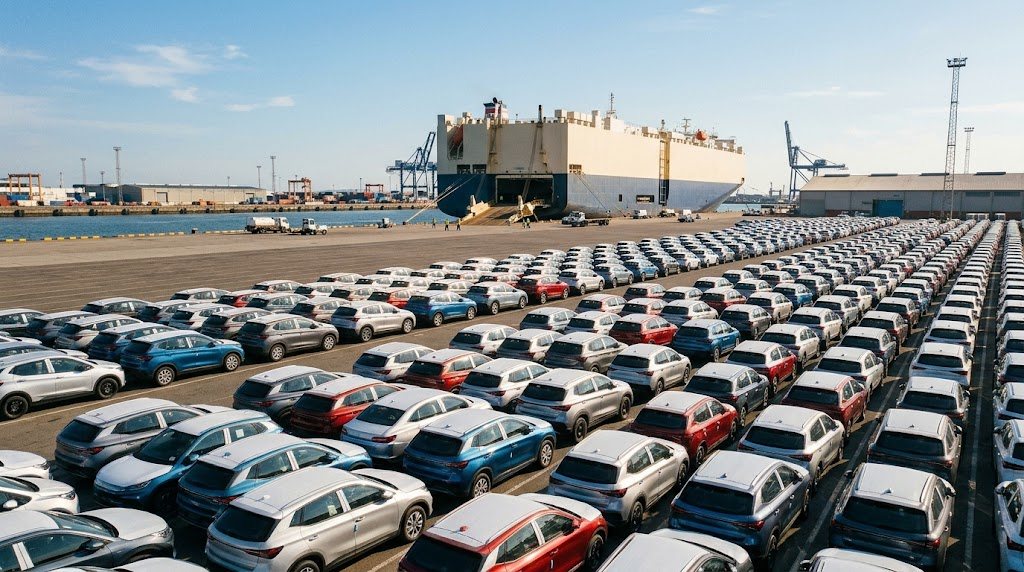
International trade is a major reason electric cars are reaching new markets so quickly. Many countries are adopting electric vehicles before they build local production, so imports provide the first wave of choice for consumers.
The IEA figures make this clear. Chinese electric car exports doubled in 2025 to a record of more than 2.5 million vehicles. In markets outside China, Europe and the United States, about 55% of electric cars sold were imported from China, up from less than 5% five years earlier.
Automakers from several regions share the global market. Chinese manufacturers supplied about 60% of electric cars sold worldwide in 2025, while European and North American automakers each accounted for about 15%. Brands from every region are expanding their model ranges and reaching more buyers.
A wider choice for buyers everywhere
For consumers, the practical result is choice. Buyers in many countries can now pick from compact city cars, family SUVs, pickups and premium models, often from several manufacturers on the same showroom floor. That variety is a major reason adoption is accelerating in markets where electric cars were rare only a few years ago.
Trade also speeds up learning. When new models arrive in a market, they bring with them dealer networks, service training, software updates and charging partnerships, building the local ecosystem that supports the next wave of buyers.
Batteries: the heart of clean-tech trade
Behind every electric vehicle is a battery pack built from a global supply chain of minerals, refined materials, cells and modules. That chain is one of the most active areas of clean energy trade.
Battery technology keeps improving, and lithium iron phosphate (LFP) chemistry has gained ground in many markets, helping manufacturers offer a wider range of models.
Production is concentrated in a few large hubs, with China producing more than 80% of the world's battery cells in 2025. As demand grows across regions, that creates wide opportunity for materials suppliers, equipment makers, logistics providers and new manufacturing sites.
Beyond cars: trucks and charging
The transition is reaching heavier vehicles as well. Global electric truck sales more than doubled in 2025, and electric models accounted for nearly one in ten trucks sold worldwide.
Charging infrastructure is expanding alongside vehicles. About 1.8 million new public charging points were added globally in 2025, bringing the worldwide total to more than 7 million. Each of those chargers represents equipment, components and installation services, much of it traded across borders.
Fleet operators are often the first movers in a new market. Delivery vans, buses, taxis and logistics trucks run predictable routes and return to the same depots, which makes them natural early adopters of electric power and steady customers for charging equipment.
The energy benefits add up. The IEA projects that electric vehicles will displace close to 10 million barrels of oil per day by 2035, equal to roughly 10% of current global oil consumption.
Riding the electric wave
Electric mobility is becoming a permanent and growing part of world trade. Companies can participate in many ways:
- Explore the supply chain. Batteries, chargers, power electronics and specialty materials all offer room for new suppliers and partners.
- Follow the fast-growing markets. Europe, Asia Pacific, Latin America and Africa are all expanding quickly, and each needs distribution, service and charging partners.
- Think about commercial fleets. Electric trucks are gaining share rapidly, creating demand for depots, charging and fleet services.
- Build cross-border relationships. Trade events and peer networks help companies meet manufacturers, importers and investors in new markets.
Five years ago, one in 25 new cars was electric. Today it is one in four. Few products have ever reshaped global trade so quickly, and the next chapter is opening up opportunities on every continent.
Sources
- International Energy Agency, Global EV Outlook 2026 (report and launch webinar presentation), May 20, 2026
- Down To Earth, Electric vehicle sales projected to reach 23 million globally in 2026: IEA report, May 2026
- Mining Weekly, Nearly 30% of all new cars sold this year to be electric: IEA, June 5, 2026