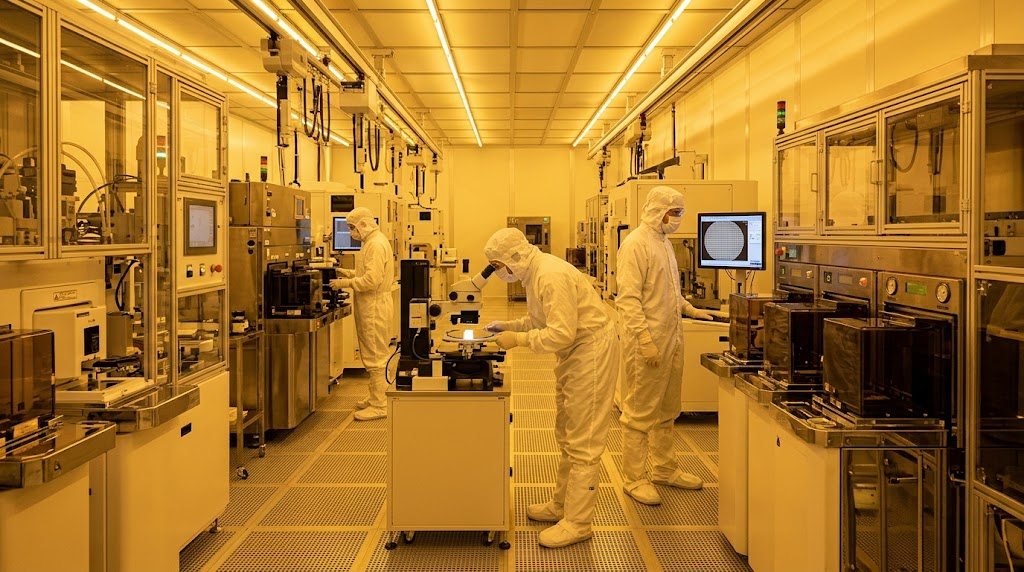
Chips, servers and chipmaking machines have become one of the strongest engines of goods trade. WTO data and a worldwide wave of new fabs show how wide the opportunity reaches.
Artificial intelligence is usually discussed as software. In world trade, it is very much hardware: chips, servers, networking gear and the precision machines that make semiconductors. That physical layer has become one of the most powerful engines of goods trade.
New data from the World Trade Organization (WTO) shows how large the effect has become. In the first half of 2025, AI-related goods accounted for a striking share of the growth in global merchandise trade, and the build-out of new semiconductor capacity on several continents points to a durable trend.
A $1.9 trillion trade category
In its October 2025 Global Trade Outlook, the WTO tracked a basket of AI-related goods, including semiconductors, servers, data center equipment and the machinery used to produce chips. Trade in these products reached about $1.92 trillion in the first half of 2025, up from $1.61 trillion a year earlier, a gain of roughly one fifth.
That growth stands out. Trade in all other goods grew by less than 4% over the same period. AI-related products make up about 15% of global merchandise trade, yet they accounted for roughly 43% of its growth in the first half of 2025.
The strength of this category was a key reason the WTO raised its forecast for 2025 merchandise trade volume growth to 2.4%. The value of global merchandise trade rose about 6% year on year in the first half of 2025, with AI-related goods doing much of the lifting.
Why AI hardware is so trade-intensive
Few products travel as much as a modern chip. Its journey can start with silicon wafers produced in one country, continue through fabrication in another and move on to packaging and testing in a third. The finished chip may then be mounted on a circuit board, built into a server and shipped to a data center on yet another continent.
Every one of those steps is a trade transaction. A single AI server can contain components from dozens of suppliers in many economies. That is why the rise of AI computing shows up so strongly in trade data, and why it benefits such a wide network of companies.
The products are also high in value relative to their weight. Chips and servers move quickly by air as well as by sea, creating demand for specialized logistics, secure warehousing and careful handling across the chain.
Where the growth is happening
The trade data shows a genuinely global supply network, with several regions contributing:
- Asia accounted for nearly two-thirds of the growth in AI-related trade in the first half of 2025, reflecting its deep base in chip fabrication, packaging and electronics assembly.
- The United States increased its semiconductor imports by 36.2% in the first half of 2025 as data center construction accelerated.
- Mexico raised its imports of AI-related goods by nearly 30%, reflecting its growing role in server and electronics assembly for North American customers.
- The European Union contributed about one tenth of AI-related trade growth in the second quarter of 2025.
Each step in the chain, from wafers to finished servers, can cross several borders. That is why AI demand shows up so clearly in trade statistics.
The machines that make the chips
One of the most telling signals is the trade in equipment used to build chips. According to the WTO, AI-related capital equipment, such as semiconductor manufacturing machines, made up almost 2% of global trade value, gaining half a percentage point in the second quarter of 2025.
Equipment trade is a forward indicator. When companies import lithography, deposition and inspection tools, they are preparing to produce chips for years to come. Rising equipment flows suggest the industry is investing in capacity that will support trade well into the future.
A build-out across many countries
That investment is visible on the ground. Chipmakers and their partners are building or expanding fabrication sites in a wider set of locations than ever before:
- United States: TSMC is producing advanced chips in Arizona, and Micron is building new memory capacity in Idaho.
- Japan: TSMC's joint venture JASM operates in Kumamoto, and Rapidus is developing advanced logic manufacturing in Hokkaido.
- Europe: The ESMC joint venture of TSMC, Bosch, Infineon and NXP is building a fab in Dresden, Germany.
- India: Tata Electronics is developing a semiconductor fab in Dholera, Gujarat.
Each new fab creates its own web of trade. It imports equipment, specialty gases, chemicals and silicon wafers, and it exports finished chips to assemblers and customers around the world. More locations mean more corridors, more suppliers and more resilient networks.
Each region brings its own strengths. The United States pairs new fabs with a vast base of chip designers and cloud customers. Japan contributes decades of expertise in materials, equipment and precision manufacturing. Europe adds deep automotive and industrial demand, while India brings a large engineering talent pool and a fast-growing electronics sector.
The result is a more distributed industry, with more places where chips are designed, made, packaged and used. For trade, that means more routes, more partners and more ways for companies of every size to participate.
The services that travel with the hardware
AI hardware also pulls services trade along with it. The WTO noted that computer services exports rose 14% in Ireland and 13% in India in the first half of 2025, driven by demand for AI, digital transformation and cybersecurity.
The pattern is intuitive. Every data center needs design, integration, software and security work. Every new fab needs engineering, training and maintenance expertise. Hardware and services expand together, and both cross borders.
Opportunities across the value chain
The AI hardware boom is not only for chipmakers. Its trade footprint reaches a wide range of companies:
- Logistics providers handling high-value, time-sensitive electronics shipments by air and sea.
- Component and materials suppliers serving new fabs with gases, chemicals, substrates and precision parts.
- Construction and engineering firms building fabs, clean rooms and data centers.
- Energy and cooling specialists supporting power-intensive data center campuses.
- Professional services firms helping companies plan sites, recruit talent and manage cross-border projects.
For trade communities, this is a natural meeting ground. Many of these companies have never worked together before, and new fab regions are creating fresh demand for local and international partners.
Finding your place in the chip supply chain
AI-related goods have become one of the clearest growth stories in world trade. A few practical steps can help you take part:
- Find your link in the chain. Consider whether your products or services support chips, servers, data centers or the facilities that build them.
- Watch the new fab regions. Arizona, Idaho, Kumamoto, Hokkaido, Dresden and Gujarat are all developing supplier ecosystems.
- Pair hardware with services. Integration, maintenance and training often follow every equipment sale.
- Connect with peers. Trade events and member networks are an efficient way to meet partners in a fast-moving sector.
The global semiconductor build-out is creating new factories, new trade routes and new partnerships at the same time. It is one of the most exciting chapters in modern trade, and it is still in its early pages.
Sources
- World Trade Organization, Global Trade Outlook and Statistics, October 7, 2025